TL;DR:
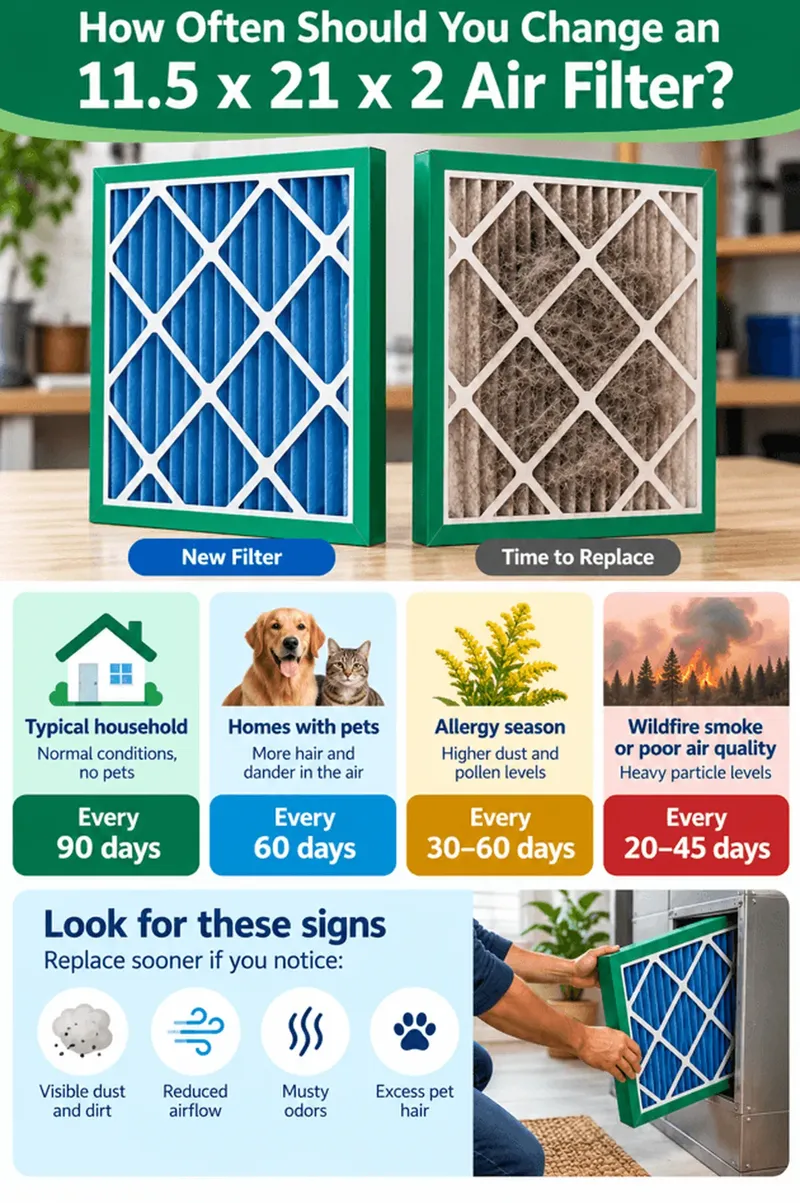
Most homes should replace a standard 11.5x21x2 pleated filter about every 90 days. If you have pets, aim for every 2 months, and if someone in the house has allergies, every 6 weeks. In humid climates where the AC rarely rests, check the filter monthly and swap it as soon as it turns gray.
A 2-inch 11.5x21x2 filter can last up to 90 days in a lightly used home. In busy or humid households where the AC runs most of the day, it usually needs replacing sooner, so the filter's condition matters more than the date on the calendar.
Key Takeaways
• Treat 90 days as a ceiling, not a target. ENERGY STAR advises checking your filter monthly and changing it at least every three months.
• Your household sets the pace. Pets and allergies shorten the interval more than anything else.
• A UV light won't stretch filter life. UV treats microbes on the coil, while the filter is what actually catches dust.
• Check the real size before you buy. Filterbuy lists the actual dimensions of an 11.5x21x2 filter as 11.5 x 21 x 1.75 inches, slightly smaller than the label.
How Long Does an 11.5x21x2 Filter Last?
A pleated 11.5x21x2 filter is designed to last up to about three months, and Filterbuy sells its 2-inch filters in this size as three-month filters. A 2-inch filter packs in more pleats than a 1-inch filter, so it holds more dust before airflow suffers. That's also why deeper 4-inch media filters can go even longer. The EPA notes that manufacturers typically recommend replacing filters every 60 to 90 days, which fits most 2-inch filters.
How long yours lasts in practice comes down to three things:
1. Run hours: how long your blower operates each day.
2. Household load: the pets, people, cooking, and outdoor dust your home produces.
3. MERV rating: finer media traps more particles, so it can fill up sooner.
What Is the Right 11.5x21x2 Filter Replacement Schedule?
Start at 90 days, whether your filter sits in a furnace or an air handler, and shorten the interval to fit your home. Filterbuy, a U.S. air filter manufacturer that makes 11.5x21x2 filters in MERV 8, 11, and 13, puts its baseline plainly: "Generally, we recommend you replace your air filters every 90 days." From there, adjust for your household:
• Standard home: every 90 days.
• Young children: every 2 to 3 months.
• Pets: every 2 months.
• Allergies or asthma: every 6 weeks. Some families add UV light installation for allergy relief.
• Heavy use, such as renovation dust or nonstop summer AC: check every 2 to 4 weeks.
The Department of Energy suggests changing central AC filters every month or two during cooling season, and in much of Florida, cooling season covers most of the year. You can confirm sizing and MERV options on Filterbuy's page for this filter size.
How Often Should You Change an 11.5x21x2 Filter With Pets?
With one pet, plan on a fresh filter about every 60 days, which lines up with Filterbuy's guidance for pet households. If you have several pets or a heavy shedder, check monthly and expect to replace it every 30 to 45 days.
Pet hair tends to mat in the center of the filter, where airflow is strongest, while the edges can still look fairly clean. When you check, look at the middle rather than the corners.
For dander, a MERV 11 filter is a common middle ground. Our guide to pet-friendly MERV 11 filters for UV light setups covers the details.
How Many 11.5x21x2 Filters Do You Need Per Year?
A year's supply makes it easier to stay on schedule. Match your count to your interval:
• Every 90 days: 4 filters a year.
• Every 2 months: 6 filters a year.
• Every 6 weeks: 8 to 9 filters a year.
• Every 30 to 45 days: 8 to 12 filters a year.
Filterbuy sells this size in multipacks and has an auto delivery option, so the next filter can show up right when you need it.
Store spares flat in their packaging inside the house. A humid garage or attic can leave the media damp before it ever goes in.
What Are the Signs of a Dirty 11.5x21x2 Filter?
Your filter will usually tell you it's done before the calendar does. Replace it right away if you notice any of these:
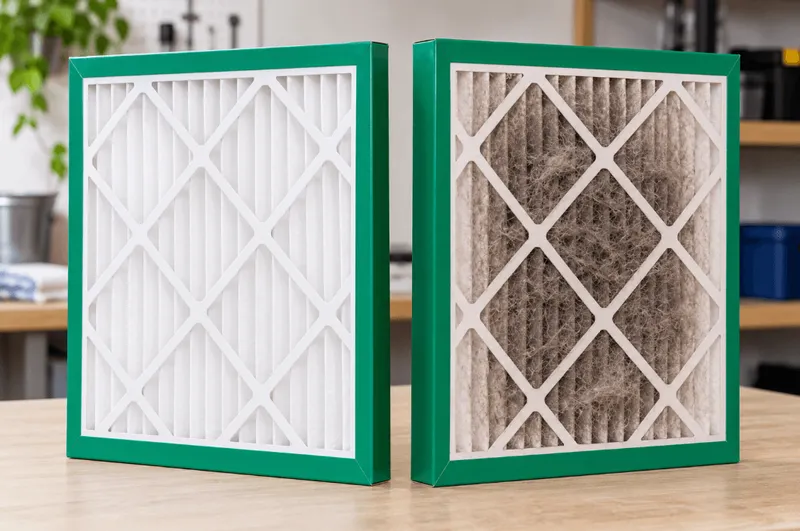
• The surface has turned gray or brown across the pleats.
• Little or no light passes through when you hold it up to a lamp.
• Airflow feels weak, and cooling cycles run longer than usual.
• Dust builds up faster on furniture and around the vents.
• Your energy bill climbs even though your habits haven't changed.
• The filter is bowing, or ice forms on the indoor coil or refrigerant line. If the ice doesn't clear after a filter change, call a technician.
Read more about how dirty air filters can harm your home.
Does an HVAC UV Light Change How Often You Replace Your Filter?
No. A UV light limits mold and bacteria on the coil, but it can't capture dust or pet hair, so your filter schedule stays the same. UV lights work best as part of a broader air quality plan that starts with regular filter changes.
The two actually depend on each other. According to the Department of Energy, a clogged filter can let air slip around it and carry dirt onto the evaporator coil, which is the very surface most UV lamps are aimed at.
In homes with UV systems, the filter acts as the UV light's first line of defense. A fresh filter keeps the coil clean enough for the lamp to do its job.
To balance filtration and airflow, see our guide to choosing the best MERV rating for your HVAC UV light system.
How to Set an 11.5x21x2 Filter Schedule You'll Stick To
1. Write the install date on the filter frame.
2. Set a monthly reminder to check the filter, even when it isn't due yet.
3. Use the run-time rule. If your AC runs most of the day in summer, shorten your interval by about a third until fall.
4. Keep a spare in the correct size on hand.
5. Check the airflow arrow so it points toward the blower.
Filter Mistakes to Avoid
• Running without a filter, even for a day, lets unfiltered air carry dust straight to the coil.
• Vacuuming and reusing a disposable pleated filter doesn't work, because the media isn't built to be cleaned.
• Forcing the wrong size lets air leak around the edges. The EPA advises a snug fit with no bending or crushing.
• Skipping a check after dusty events. Drywall repair or storm cleanup can fill a filter in days.
Essential Resources on 11.5x21x2 Air Filters: 7 Trusted Guides
1. Confirm the Exact Fit and Compare MERV Options
Filterbuy: 11.5x21x2 Air Filters lists true dimensions and MERV options.
2. Choose the Right Filter Rating
EPA: Guide to Air Cleaners in the Home explains how to choose an HVAC filter and when to replace it.
3. Set a Schedule Backed by Federal Guidance
ENERGY STAR: Heat & Cool Efficiently lays out the monthly check and three-month minimum.
4. Prevent Costly Repairs With a Seasonal Checklist
ENERGY STAR: Maintenance Checklist shows where filter changes fit into yearly system care.
5. Lower Cooling Bills With a Clean Filter
U.S. Department of Energy: Maintaining Your Air Conditioner explains how your filter affects AC efficiency and coil health.
6. Protect Pet Owners and Allergy Sufferers
EPA: Biological Contaminants and Indoor Air Quality explains how pet allergens and dust mites affect indoor air.
7. Stop Mold at the Source in Humid Climates
EPA: A Brief Guide to Mold, Moisture and Your Home explains why moisture control, not filtration alone, prevents mold.
Supporting Statistics: Federal Research on Filter Changes
1. A Clean Filter Cuts AC Energy Use by 5% to 15%
The stat: Replacing a dirty, clogged filter can lower AC energy use by 5% to 15%.
Why it matters: On-time changes keep cooling bills in check.
Source: U.S. Department of Energy
2. Airflow Problems Reduce Efficiency by Up to 15%
The stat: Airflow problems can cut HVAC efficiency by up to 15%.
Why it matters: A clogged filter is a common cause of restricted airflow.
Source: ENERGY STAR
3. Filters Only Clean Air While Your System Runs
The stat: Most HVAC systems run less than 25% of the time during heating and cooling seasons.
Why it matters: Humid-climate homes run much longer, so filters fill faster.
Source: U.S. Environmental Protection Agency
What Does a Late Filter Change Really Cost?
Apply the Department of Energy's 5% to 15% range to the cooling share of your bill:
1. Say cooling accounts for $150 of your monthly summer electric bill.
2. A clogged filter could then be costing you $7.50 to $22.50 a month.
3. Across the four hottest months of the year, that adds up to $30 to $90.
Your numbers will depend on your rate and home size.
Your Next Step
Pull your filter today and take a look at the center of the pleats. If it's gray, replace it now, and write today's date on the new frame before you slide it in.
Frequently Asked Questions
Is 90 days too long for an 11.5x21x2 filter?
Usually not for an average home, but in humid climates with year-round AC, many filters fill up sooner.
Does a higher MERV filter need changing more often?
Often, yes. Finer media fills faster in dusty or pet-heavy homes. Filterbuy positions MERV 11 for allergy sufferers and MERV 8 as its standard option.
Should I change my filter before a UV light installation?
Yes. A clean filter protects the coil your new UV system will treat.
Can I wash and reuse an 11.5x21x2 pleated filter?
No. Disposable pleated filters aren't built to be cleaned, so vacuuming or rinsing one won't restore it. Replace it with a new filter instead.
Which way should the airflow arrow point on a new filter?
Toward the blower, which is away from the return grille. A backward filter can let dust slip past the media.
Glossary
11.5x21x2 air filter: A nominal HVAC filter size whose actual dimensions are about 11.5 x 21 x 1.75 inches.
MERV: A rating scale that, according to the EPA, reports how well a filter captures particles from 0.3 to 10 microns.
HVAC UV light: An ultraviolet lamp that limits microbial growth on coils and nearby surfaces. It does not replace a particle filter.
Filterbuy: A U.S. air filter manufacturer that makes the 11.5x21x2 size in MERV 8, 11, and 13.
Learn more about HVAC Care from one of our HVAC solutions branches…
Filterbuy HVAC Solutions - Miami FL - Air Conditioning Service
1300 S Miami Ave Apt 4806 Miami FL 33130
(305) 306-5027
https://maps.app.goo.gl/Ci1vrL596LhvXKU79


